Experimental technology becomes useful when a prototype answers a real question. Haptics, stereoscopic 3D, and projection work taught me to test the uncertain part first.
Technology demonstrations are easy to admire and difficult to evaluate. A convincing demo may prove that an effect is possible without proving that it can survive a venue, a deadline, an audience, or repeated use.
The purpose of a prototype is not to look like a smaller finished product. It is to reduce uncertainty. The best prototype is often rough in every area except the question it was built to answer.
Name the uncertainty
“Can we build this?” is usually too broad. Better questions are observable. Can a viewer perceive depth at this distance? Can the mechanism respond quickly enough? Can the projection remain aligned when the camera moves? Can an operator repeat the setup? Can the audience understand the interaction without explanation?
One prototype should answer one important uncertainty. Everything else can remain temporary.
Haptics makes the hidden system physical
Haptic work connects software, sensors, mechanics, timing, human perception, and physical safety. A delay that would be tolerable on a screen can feel wrong through the hand. A mathematically accurate response may still be uncomfortable or unclear.
The haptics and stereoscopic 3D work reinforced a principle I have carried into later systems: technical correctness is only one layer of success. The user experiences the whole chain, including latency, ergonomics, instructions, and expectation.
Stereoscopic 3D begins with human vision
Stereoscopic images are created by delivering related but different views to each eye. The mechanics are straightforward to describe; comfortable depth is more subtle. Camera separation, convergence, lens choice, subject distance, screen size, and viewing position all affect the result.
A small test viewed under the wrong conditions can produce false confidence. Prototypes should therefore recreate the critical part of the final experience, not merely the easiest part to demonstrate.
Custom rigs are arguments made physical
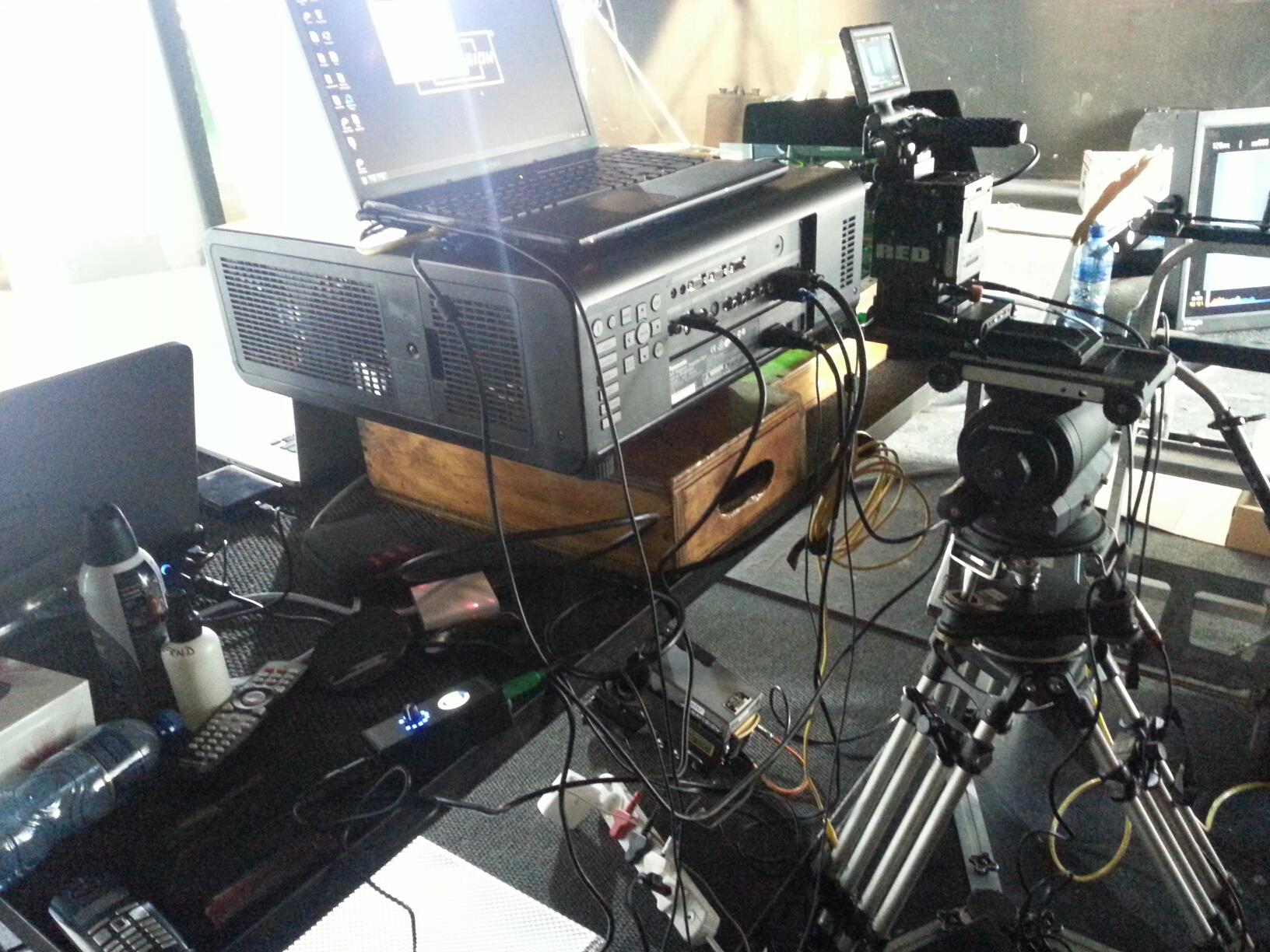
The front-projection camera rig and chroma projection rig were practical answers to specific imaging problems. Sketches, paired hardware, fabrication, alignment, and camera tests progressively replaced assumptions with evidence.
A custom rig should not exist merely because fabrication is interesting. It should make a useful result possible, repeatable, or affordable. Each adjustment point, material choice, and mounting decision should trace back to the image or operation it protects.
Test the interfaces
The greatest uncertainty often lives between components: camera and projection surface, software and actuator, operator and control, render and display, idea and audience. Testing each component separately can miss the failure that appears only when they interact.
- Use the real signal path as early as possible.
- Test at the intended scale or identify what scale changes.
- Let an unfamiliar person operate or experience the prototype.
- Record settings, distances, versions, and environmental conditions.
- Decide in advance what result would stop or redirect the idea.
A failed prototype can be a successful test
If a prototype disproves an assumption before the expensive build begins, it has done valuable work. Failure becomes wasteful when the question was unclear, the result was not recorded, or the same uncertainty returns unchanged.
That is why prototyping belongs inside a larger learning system. Capture the conditions, structure the observation, act on it, and preserve what the result means for the next decision.
Browse the project evidence behind these experiments, or discuss an unusual technical idea.