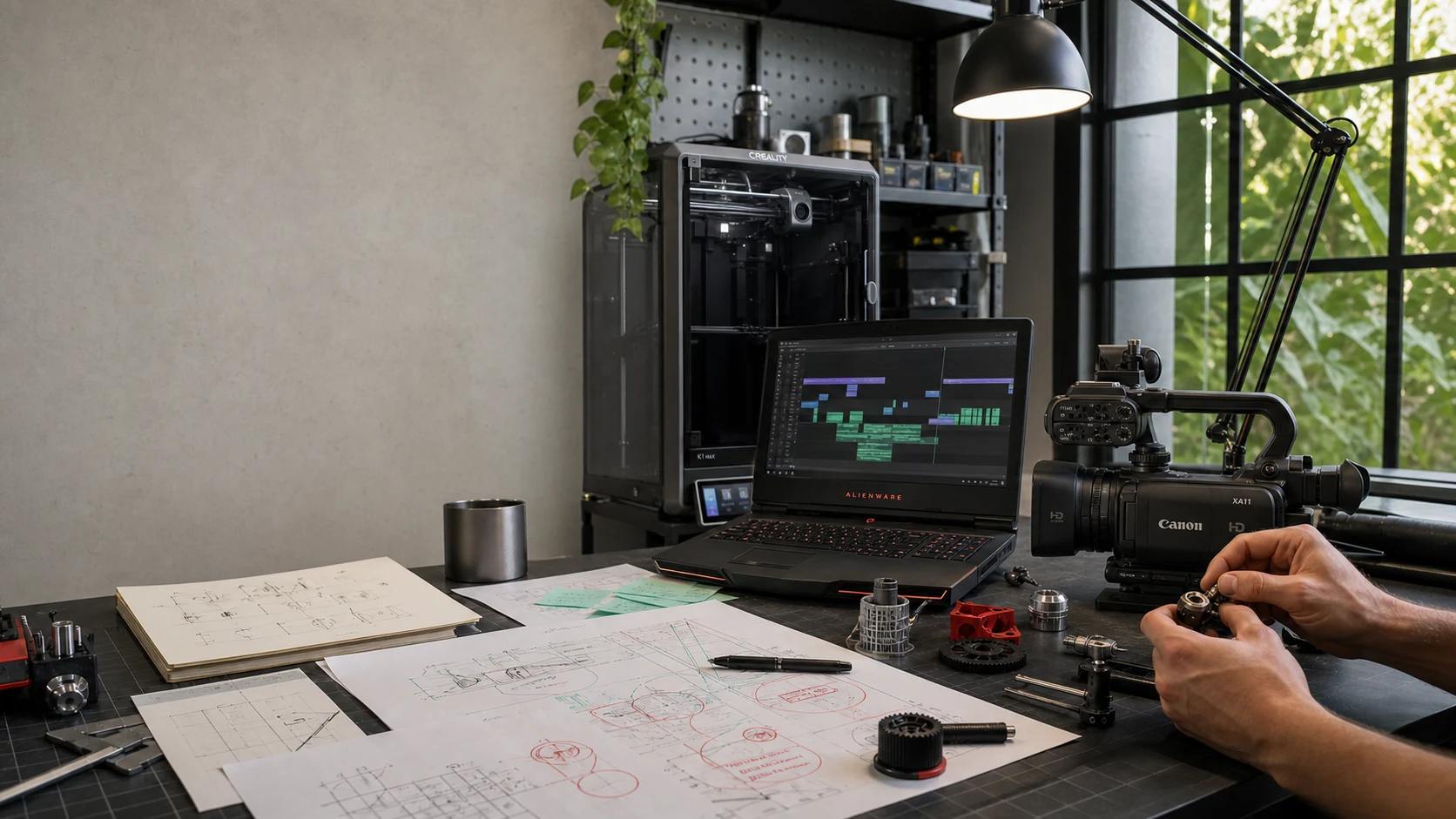
The visible creative work is only one part of production. Strong delivery depends on the system connecting the brief, people, media, approvals, technology, and deadline.
Creative production is often discussed as a sequence of specialist tasks: write, shoot, design, animate, edit, mix, deliver. That description is accurate, but incomplete. Projects rarely fail because nobody knows how to operate a camera or design a frame. They fail in the spaces between the tasks.
A brief changes without reaching the editor. The correct logo exists but cannot be found. A venue uses a different screen ratio. A late approval removes the time reserved for rendering. The content is good, yet the system around it makes delivery fragile.
The work has two products
Every production creates a visible product and an operational product. The visible product is the film, animation, photograph, presentation, stream, or event experience. The operational product is the chain that allowed it to be made: decisions, files, responsibilities, approvals, tools, and hand-offs.
Clients experience both. They see the final work, but they also experience whether communication is calm, versions are controlled, changes are understood, and delivery is dependable. A beautiful result produced through chaos may be difficult to repeat and expensive to maintain.
Start with relationships, not software
New tools are tempting because they promise control. Before choosing them, map the relationships. Who supplies information? Who turns it into a decision? Which assets are shared? What must be approved? Where does the final output go? What happens when one participant is late?
Once those relationships are visible, software can support them. Without that map, a new platform often becomes another place to search.
A file structure is a production decision
Naming, storage, and versioning can sound administrative until the wrong render reaches a screen. A useful structure answers practical questions quickly: Which version is current? Which source is approved? What can be safely deleted? Which deliverables belong together? Can another person continue the work?
This thinking has shaped both Pulse Works production and the long-running Working Archive. Media becomes more valuable when its context survives with it.
Design approvals as part of the work
An approval is not merely a message saying “looks good.” It is a dependency. The reviewer needs enough context to make the decision, the production needs a clear deadline, and everyone needs to know what changes after approval will cost.
Good review stages ask focused questions. Is the factual content correct? Is the direction approved? Are we reviewing timing, colour, sound, or all of them? A vague request for feedback often creates vague changes.
Protect the deadline with intermediate outputs
A single final deadline hides risk. Strong workflows create intermediate outputs that prove the system is working: a technical test, a short rendered section, a sample screen, a camera test, a rehearsal recording, or a draft delivered through the real channel.
These are not ceremonial milestones. They expose incompatible formats, unrealistic timings, missing information, and unstable technology while there is still room to respond.
The system should serve the work
Process can become its own form of clutter. The answer is not maximum documentation or a meeting for every decision. The answer is the lightest system that makes the important things clear.
That may be a one-page brief, a shared folder with disciplined names, a visible decision log, and a short delivery checklist. For a larger production it may require formal schedules, asset tracking, redundancy, and role-specific sign-off. The scale changes; the purpose does not.
Creative freedom and operational discipline are not opposites. A clear system protects the time and attention needed to make good creative decisions.
See how this thinking becomes a repeatable cycle in Warwick’s Method.